

A numerical model of the formation, at low velocity, of satellites in binary asteroid systems was Published on November 17th in the journal Icarus by a research team from IPGP and Université Paris Cité. This model, suggesting the existence of “contact binary” satellites, has just been validated by observations of the flyby of the binary asteroid Dinkinesh by NASA’s Lucy mission.
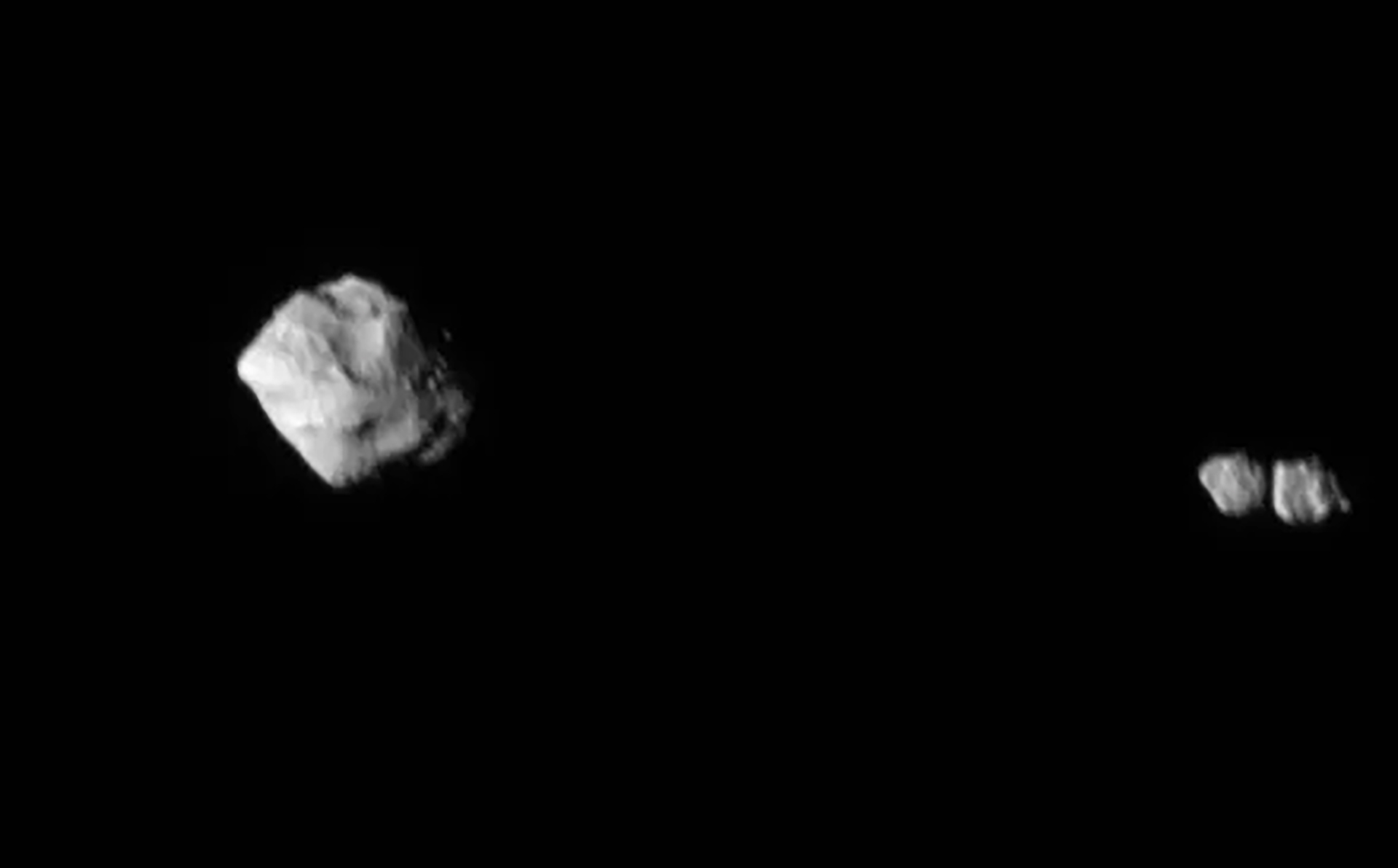
© NASA/Goddard/SwRI/Johns Hopkins APL
A significant fraction of the asteroids in our Solar System are binary objects, i.e. they consist of a main body and a satellite orbiting the main asteroid. The pairing of Ida (main body) and Dactyl (satellite), for example, was photographed by the Galileo probe back in 1994, and the formation of this type of object was generally explained by collisions between asteroids.
In recent years, new observations have revealed a new category of binary asteroids, whose main body is diamond-shaped, with a large equatorial protuberance. For these systems, current models explain the morphology of prolate (rugby ball-shaped) companion satellites by a rapid or instantaneous ejection of debris from the main asteroid leading to the rapid formation of the satellite.
However, close-range observation by NASA’s DART mission in 2022 of the Didymos (main body) and Dimorphos (satellite) pair (which will also be the target of the Hera mission carried out by ESA in 2026 under the scientific responsibility of researchers from CNRS and OCA1), shows that the system’s satellite does not have the expected prolate morphology.
Two researchers from the IPGP and Université Paris Cité have carried out a series of numerical experiments to propose a mechanism for the formation of this asteroid system, inspired by a model previously proposed for the formation of Saturn’s satellites.
In a paper published on 17 November in the journal Icarus, the two researchers suggest that the satellite could also have formed from a ring of debris ejected at low velocity by the main body. They propose that if the loss of material occurs over a longer period (of the order of a few years), a new satellite formation regime emerges – the ‘pyramidal regime’ – in which satellites are formed by low-velocity collisions of objects of similar size, the end result being the formation of a ‘binary contact’ satellite, if two proto-satellites remain stuck together, or an oblate satellite (in the shape of a flattened sphere) if two proto-satellites merge.
The latter oblate morphology corresponds to the shape observed for the Didymos/Dimorphos asteroid pair, whereas the contact binary morphology was purely theoretical until now.
But this morphology has just been validated in a timely fashion by NASA’s Lucy mission, on1 November, during the first flyby of the asteroid Dinkinesh. This first observation led to the discovery that Dinkinesh was, in fact, a binary asteroid. Even more astonishingly, the images also revealed that its satellite has a “contact binary” morphology, as predicted by the IPGP team.
This observation, the first ever for a contact binary satellite, could therefore indicate that Dinkinesh’s satellite formed over timescales of several years, from the mass gradually lost by the main body.
1- Hera is ESA’s first planetary defence mission. The scientific leaders of the mission are researchers from the CNRS and the Observatoire de la Côte d’Azur (OCA), working at the Lagrange laboratory (CNRS/OCA/Université Côte d’Azur).
Bibliography:
> Revisiting Dimorphos formation: A pyramidal regime perspective and application to Dinkinesh’s satellite, Gustavo Madeira, Sebastien Charnoz, Icarus, Vol. 409, 2024.
DOI: 10.1016/j.icarus.2023.115871
Read more

Doctoral Mobility: Results of the Call for Projects between Université Paris Cité and the University of Toronto
As part of the strategic partnership between Université Paris Cité (UPCité) and the University of Toronto (U of T), supported by the Initiative d'Excellence (IdEx), the call for doctoral mobility projects launched in 2026 aims to develop joint activities around themes...
read more
The Covid-19 Pandemic Memorial Site opens to the public
Starting Wednesday 16 September, the Covid-19 Pandemic Memorial Site will welcome visitors every Wednesday, from 2 p.m. to 5.30 p.m., at Université Paris Cité’s Odéon headquarters, located at 12 rue de l’École de médecine. Admission is free and no registration is...
read more
Learn French as a foreign language with ‘Décalages culturels’, the podcast from RFI and Université Paris Cité
Born out of a partnership between RFI and Université Paris Cité, and spearheaded by its Pedagogical Innovation Department, the podcast ‘Décalages culturels’ has been running since March as part of the programme ‘8 milliards de voisins’. Having explored the...
read more
Graduate School Summer Schools: opportunities to learn, collaborate and broaden your horizons
Each year, the Graduate Schools of Université Paris Cité organize their summer schools, offering unique opportunities for learning, scientific exchange and collaboration. Students, PhD candidates and researchers come together to explore a wide range of topics,...
read more