


Scientists from the Institut Pasteur, the CNRS, the Institut universitaire de France, Université Paris Cité and the Paris Public Hospital Network (AP-HP) compared genetic data from 13,000 individuals with autism and nearly 200,000 individuals from the general population. While 4% of those with autism were found to carry strong genetic variations implicated in autism, the same variations were also observed in nearly 1% of individuals from the general population, who were also found to have poorer cognitive performance and a lower socioeconomic status. The results of the study were published in the journal Nature Medicine on June 26, 2023.
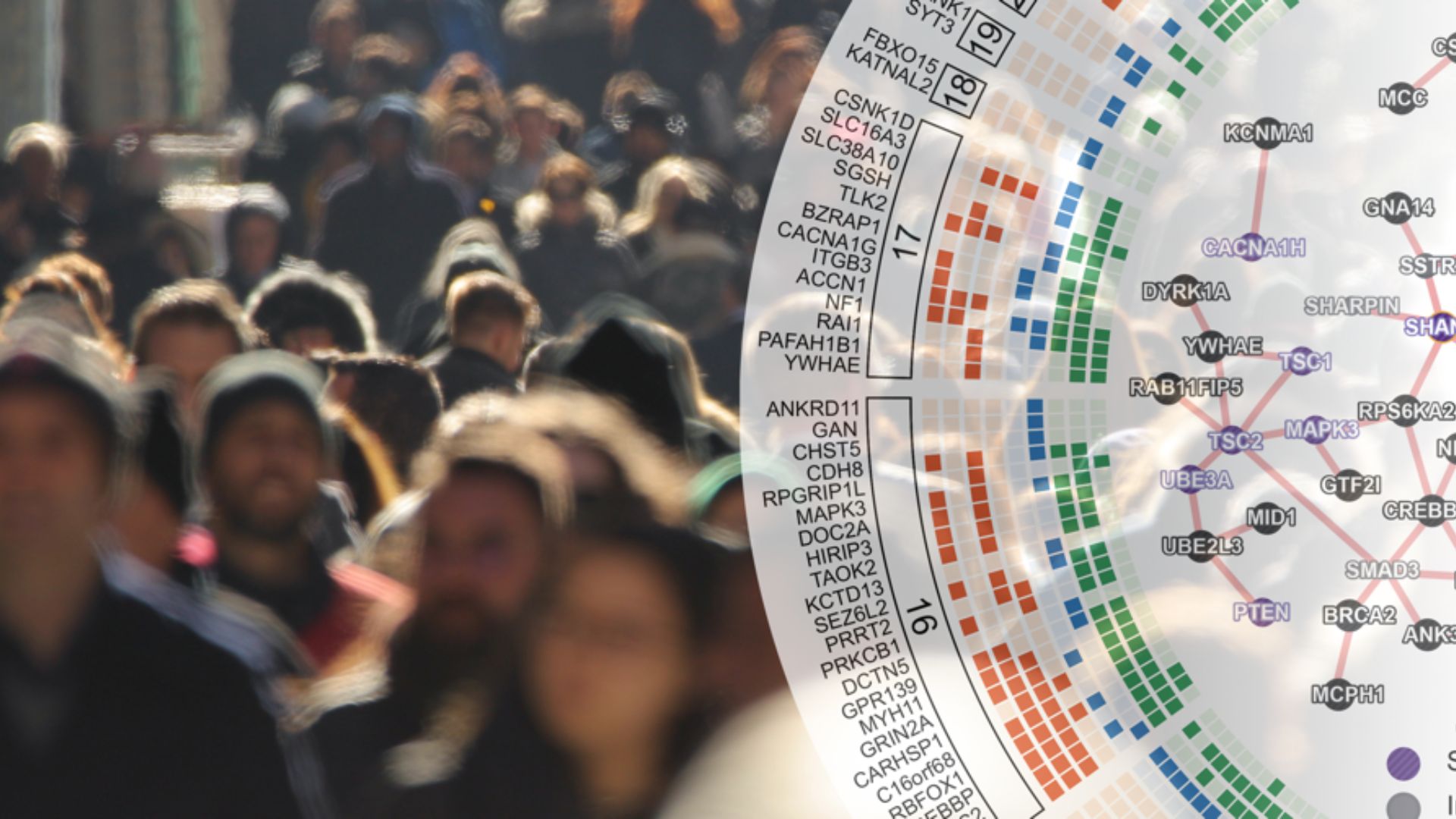
Photo montage © Institut Pasteur/Anne Burlet-Parendel. Left: Crowd of people (©AdobeStock). Right: A map showing autism vulnerability genes over the entire genome (©Institut Pasteur).
Autism is a neurodevelopmental condition diagnosed by assessing atypicalities in social communication and the presence of restricted or repetitive behaviors, activities or interests. It is now well established that autism has a strong genetic component. The first genes associated with autism were discovered in 2003 in the laboratory led by Professor Thomas Bourgeron at the Institut Pasteur. Since then, rare variations in more than 200 genes have been identified, illustrating the complexity of the mechanisms involved in the onset of autism.
“The reason we embarked on this research was to improve our understanding of the genetic architecture of autism – the combination of genes and variants underpinning its expression – and to identify the factors that modulate the intensity of autism symptoms,” explains Thomas Rolland, a CNRS scientist in the Human Genetics and Cognitive Functions Unit[1] at the Institut Pasteur and first author of the study. “Since these are rare genetic variations, each affecting just a small percentage of individuals with autism, we first needed to gather data for a large number of individuals. The original idea was then to see whether these variants were present among the general population – in other words in people not diagnosed with autism – to see what effect they had, if any.”
The scientists analyzed the genetic data of 13,000 individuals diagnosed with autism from several cohorts used by various partners at the international level.[2] They compared these data with those of a general population cohort not diagnosed with autism, composed of 180,000 individuals.[3] As Thomas Rolland explains, “We focused on rare variants from a list of 185 genes that were known to be strongly associated with autism. And we did indeed find these variants in 4% of individuals with autism. What was more surprising was that some of the variants were also observed in 1% of undiagnosed individuals. This suggests that autism is the result of a conjunction of factors, both genetic and environmental.”
To help shed light on the effect of these variants, the team compared this information with the medical, cognitive and socioeconomic data of the undiagnosed individuals. “The variants seem to affect the cognitive performance of carriers without an autism diagnosis, as well as their educational level (lower-level qualifications), their salary (lower net income) and their material living conditions,” says Richard Delorme, a Professor at Université Paris Cité, Head of the Child and Adolescent Psychiatry Department at Robert Debré Hospital (AP-HP) and a scientist at the Institut Pasteur.
“Our observations show once again just how complex the architecture of autism is! It can occur genetically in more than one way. A person may carry a rare genetic variation that has such a strong effect that it appears to single-handedly lead to autism. Alternatively, there may be a conjunction of a series of variations in a given individual. On their own they would have no significant effect or only a mild effect, but together they contribute to the emergence of autistic symptoms in that individual, and in some cases a diagnosis,” explains Thomas Bourgeron, Professor at Université Paris Cité, Head of the Human Genetics and Cognitive Functions Unit at the Institut Pasteur and last author of the study. Also of note is the fact that female individuals with autism were found to be more likely to carry the rare genetic variants associated with an autism diagnosis. But the data also show that in the general population, the probability of carrying these variants is the same for women and men. “The results suggest that men are more likely to have autism when they carry variants with a lower effect size than women.”
Professor Thomas Bourgeron concludes, “What we have observed with these variants is just the tip of the iceberg, as they cover only a small percentage of identified cases of autism. Further studies and larger sample sizes are needed to investigate additional genes associated with autism and other types of genetic variations. The architecture of autism is very complex, and the environment, in a broad sense, plays a crucial role in symptom intensity and quality of life. That is why it is so important to adopt an integrated approach to study autism that takes their environment into account. It is only by doing so that we will be able to identify the factors that modulate the onset and intensity of symptoms experienced by individuals with autism and develop effective, personalized support programs.” A university hospital institute, inovAND, was recently established at Robert-Debré Hospital (AP-HP) to explore these questions, and an international study, R2D2-MH, funded by the European Commission and based on the principle of participatory research, is being coordinated by Professor Thomas Bourgeron. The aims of these initiatives are to determine all the factors and support mechanisms that can improve the trajectory for people with neurodevelopmental vulnerabilities.
This research was conducted in close collaboration with scientists and physician-scientists from the institutions cited above, as well as the University of Montreal (Canada), Aarhus University (Denmark), Columbia University (United States), the University of Cardiff and the University of Cambridge (United Kingdom) and the Simons Foundation (United States).
[1] At the CNRS, this unit is known as the “Genes, Synapses and Cognition Unit” (CNRS/Institut Pasteur).
[2] Simons Simplex Collection (SSC), Simons Powering Autism Research for Knowledge (SPARK) and Lundbeck Foundation Initiative for Integrative Psychiatric Research (iPSYCH).
[3] The British database UK Biobank.
Read more
Prix Jeunes Talents France L’Oréal-UNESCO Pour les Femmes et la Science : Appel à candidatures 2026
La Fondation L'Oréal, en partenariat avec la Commission nationale française pour l'UNESCO et l'Académie des sciences, déclare officiellement ouvert l'appel à candidatures de l'édition 2026 du Prix Jeunes Talents France L'Oréal-UNESCO Pour les Femmes et la Science :...

International Day of Women and Girls in Science: celebrating the women who push research forward
February 11 was the International Day of Women and Girls in Science. On this day, Université Paris Cité reaffirms its commitment to the equality between men and women and celebrates the journey of the women who advance research. Between celebrating our heritage and...

Suivi des maladies chroniques : un patient sur deux serait ouvert à la téléconsultation
L’étude REACTIVE, coordonnée par la Dre Tiphaine Lenfant et le Pr Viet-Thi Tran et menée par des équipes de médecine interne de l’hôpital européen Georges-Pompidou AP-HP, du centre d’épidémiologie clinique de l’hôpital Hôtel-Dieu AP-HP, de l’Université Paris Cité, de...
Journée internationale des femmes et des filles de science : célébrer celles qui font avancer la recherche
Le 11 février marque la Journée internationale des femmes et des filles de science. À cette occasion, l’Université Paris Cité réaffirme son engagement en faveur de l’égalité femmes-hommes et célèbre le parcours de celles qui font avancer la recherche. Entre un...