

By analysing the data collected during 2 years by the Rosetta spacecraft, researchers of the Laboratoire d’Etudes Spatiales et d’Instrumentation en Astrophysique (LESIA), find evidences that the periodic comet 67P Churyumov-Gerasimenko is indeed a binary object.
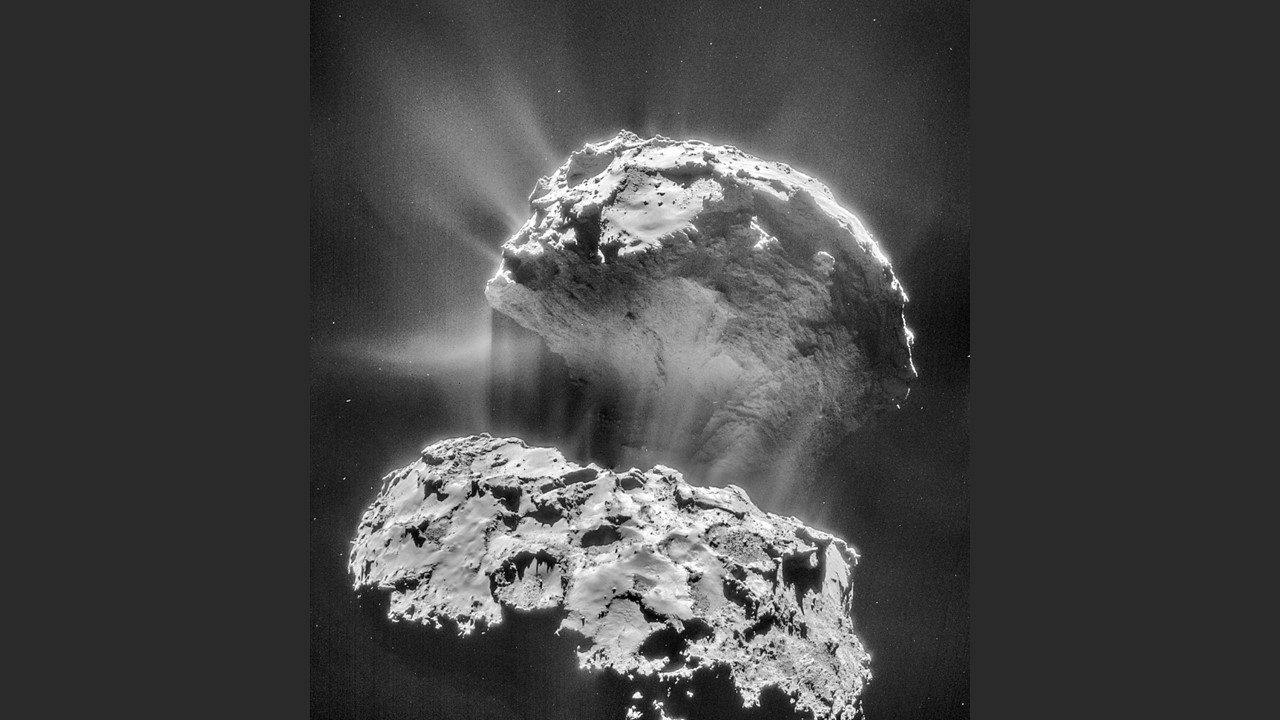
© ESA
Comets are small primitive bodies whose composition and structure have barely evolved since the beginning of the solar system. They thus preserve precious information on the primordial Solar System and on how it evolved. By studying comets, scientists learn to understand the evolution of the structure and composition of other bodies such as the planets, which have evolved significantly since the formation of the solar system.
Comets come from reservoirs in the outer solar system and are predominantly icy. It is when they get closer to the sun that volatile elements such as ices (water, carbon dioxide…) start to sublimate and form the coma and its tails.
Containing ice and organic matters, including amino acids, which are the building blocks of life, comets provide scientists the opportunity to test several theories, including the formation of water on Earth. As for the amino acids present on comets, could they have fostered the appearance of life on Earth?
Rosetta is the cornerstone mission of the European Space Agency (ESA) space exploration programme dedicated to small bodies. The mission has made it possible to study and gather data that characterised the environment and the surface of a comet nucleus. In fact, the Rosetta spacecraft, placed in orbit around the comet 67P for 2 years, gave LESIA researchers the opportunity to follow the evolution of 67P nucleus from the further heliocentric distances of its orbit as it approaches the sun. It is a precious and unique dataset which researchers have available both for nowadays and future analysis.
Their research focuses on an in-depth analysis of the geomorphology, surface changes, compositional evolutions and distribution of water ice present in Wosret, a region located in the small lobe of the comet. This region, like others in the southern hemisphere of the nucleus, is one of the most active and most eroded, because it is exposed to the most intense solar flux during the perihelion passage (the closest point of the comet’s orbit).
Sonia Fornasier, lecturer at the Laboratoire d’Etudes Spatiales et d’Instrumentation en Astrophysique (LESIA), head of the LESIA planetology pole at Université Paris Cité and senior member of the Institut Universitaire de France.
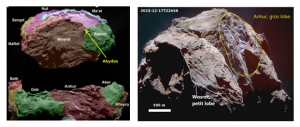
Left: the southern hemisphere of comet 67P. The Wosret region takes up most of the southern hemisphere of the small lobe. Abydos, also in the Wosret region, is the final site of the Philae lander. Right: Wosret and Anhur in RGB color image from the OSIRIS instrument. Many bright and spectrally blue areas associated with exposure of water ice are observed on the surface on Anhur, while there is very little exposed ice on Wosret.
With over 40 identified sources of cometary activity, Wosret is a very active region. However, this activity does not cause much change in the surface. For example, researchers have observed the formation of a cavity 30m in length and 6m deep, and a thinning of the dust layer of only one meter on a limited surface. Hence, the outgassing of matter during the perihelion passage causes a loss of mass estimated at only 1.2 million kilograms on the Wosret region. Despite the strong activity in this region, reflecting the existence of thick, deep water ice, the latter is rarely exposed directly at the surface, and can be found on very small areas (<2 m2).
On the other hand, many morphological changes have been observed on Anhur and Khonsu, two regions also located in the southern hemisphere but on the large lobe of the comet. They are exposed to the same intense heating conditions as Wosret and they are also equally active. Here researcher have previously reported several morphological changes, resulting in a higher mass loss, from 50 to 170 million Kg. A higher abundance of frost and water ice is also observed in these regions [1].
The comparison between different regions of the 2 lobes, subjected to similar intense solar fluxes and exposing the primordial and least altered layers of the comet, has made it possible to demonstrate that the material of the small lobe of the comet has physical and mechanical properties quite different from the one constituting the large lobe. The small lobe is composed of more consolidated and less fragile material than the large lobe, and lacks volatile material (such as water and carbonic ice), at least for the few tens of centimeters of the uppermost layers.
These results reinforce the hypothesis previously formulated on the basis of the study of cometary nucleus stratification, that the comet is in fact a binary body, formed by the merging of two initially independent objects that collided at low speed during the first formation phases of the solar system.
[1] https://u-pariscite.fr/la-comete-tchouri-devoilee-par-la-mission-rosetta/ [Fornasier et al., 2019, Astronomy & Astrophysics, Volume 630, id.A13 ; Hasselmann et al. 2019, Astronomy & Astrophysics, Volume 630, id.A8 ].
References
Small lobe of comet 67P: Characterization of the Wosret region with ROSETTA-OSIRIS. S; Fornasier, J. Bourdelle de Micas, P. H. Hasselmann, H. V. Hoang, M. A. Barucci and H. Sierks. Astronomy & Astrophysics 653, A132, 14p.
DOI: https://doi.org/10.1051/0004-6361/202141014
Open access : https://www.aanda.org/articles/aa/pdf/2021/09/aa41014-21.pdf
Read more
Doctoral Mobility: Results of the Call for Projects between Université Paris Cité and the University of Toronto
As part of the strategic partnership between Université Paris Cité (UPCité) and the University of Toronto (U of T), supported by the Initiative d'Excellence (IdEx), the call for doctoral mobility projects launched in 2026 aims to develop joint activities around themes...
read more
The Covid-19 Pandemic Memorial Site opens to the public
Starting Wednesday 16 September, the Covid-19 Pandemic Memorial Site will welcome visitors every Wednesday, from 2 p.m. to 5.30 p.m., at Université Paris Cité’s Odéon headquarters, located at 12 rue de l’École de médecine. Admission is free and no registration is...
read more
Learn French as a foreign language with ‘Décalages culturels’, the podcast from RFI and Université Paris Cité
Born out of a partnership between RFI and Université Paris Cité, and spearheaded by its Pedagogical Innovation Department, the podcast ‘Décalages culturels’ has been running since March as part of the programme ‘8 milliards de voisins’. Having explored the...
read more
Graduate School Summer Schools: opportunities to learn, collaborate and broaden your horizons
Each year, the Graduate Schools of Université Paris Cité organize their summer schools, offering unique opportunities for learning, scientific exchange and collaboration. Students, PhD candidates and researchers come together to explore a wide range of topics,...
read more