

Innovative Materials
The Graduate School of Innovative Materials aims to train students in the fields of soft condensed matter and materials science. This training allows students to image and explore new ways of designing new materials and understanding complex systems to meet the challenges of tomorrow.
Presentation
To order to meet future challenges in the fields of health and preservation of the planet, there is a growing need of research and training regarding innovative materials and complex systems to understanding future societal issues.
With this in mind, the Graduate School of Innovative Materials encourages students’ interest in the design of new materials. So that they can apprehend and understand the design of complex systems emerging from the current challenges of society. With a broad field of research on application (bioengineering, catalysis, optical devices, telecommunications, medicine, energy, information storage and reading), the Graduate School of Innovative Materials aims to train experts able to study the fundamental properties of these new materials interacting with their surrounding environment.
All these subjects benefit from new developments in modelling and simulation, as well as from the breakthrough of artificial intelligence in all fields of science. Through this interdisciplinary approach, the aim of the Graduate School of Innovative Materials is to train experts with a broad scientific background, fostering interactions between different disciplines: notably physics, chemistry, biology, geophysics and medicine, in order to make dramatic progress in understanding and meeting future needs.
Masters
List of Masters taught in French and English:
- Master of Physics
- Fundamental physics and applications:
- Earth and planetary sciences, environment:
- Engineering degree:
List of Masters taught in English:
- Fundamental physics and applications:
- Health engineering:
Research
The research topics of the Graduate School of Innovative Materials cover all aspects of materials science and include the following fields:
- Bio-materials, bio-material synthesis and bio-genetic materials
- Complex systems and soft matter
- Detection and metrology devices (meta-materials, quantum sensors, time-resolved IR/Raman spectroscopy and microscopy…)
- Interaction of materials with their environments (gaseous and liquid environments, natural environments…)
- Life cycle of materials in their environments, biological and environmental impact
- Materials eco-conception
- Materials for implants-prostheses
- Nano-materials for health and environment
- Nano-physics: nano-electronics, nano-photonics, nano-magnetism, nano-electromechanics…
- Surface science and nano-structures, new materials: oxides, alloys, composites, organic-inorgonic hybrids, nano-particles, bio-mineralisation, bio-inspired materials
The Graduate School of Innovative Materials offers students a cross-disciplinary training, in order to provide them with the best knowledge and skills:
- Interdisciplinary approaches with research teams working in physics, chemistry, earth and environmental sciences, biology and health;
- Knowledge and understanding of the societal impact with work ranging from fundamental research to practical applications;
- A strong involvement of start-ups, small and medium-sized enterprises, ensuring that students have a high level of pratical training;
- But also privileged access to advanced technology platforms using the latest instrumental developments.
Laboratories
- T3S – environmental Toxicity, Therapeutic Targets, cellular Signaling and Biomarkers (UMR 1124)
- CAP Paris Tech (UMR U 1275)
- IPGP – Institut de Physique du Globe de Paris (UMR 7154)
- ITODYS – Interfaces Traitements Organisation et Dynamique des Systèmes (UMR 7086)
- IVETh – The technological expertise platform for the production, engineering and characterisation of Extracellular Vesicles for personalised Therapies
- MPQ – Laboratoire Matériaux et Phénomènes Quantiques (UMR 7162)
- MSC-MED – Antenne Laboratoire Matière et Systèmes Complexes (UMR 7057)
- PCC – Physico-chimie Curie (UMR 168)
- PMMH – Physique et Mécanique des Milieux Hétérogènes (UMR 7636)
Executives
- Prof. Christian RICOLLEAU
Professor at Université Paris Cité
À lire aussi
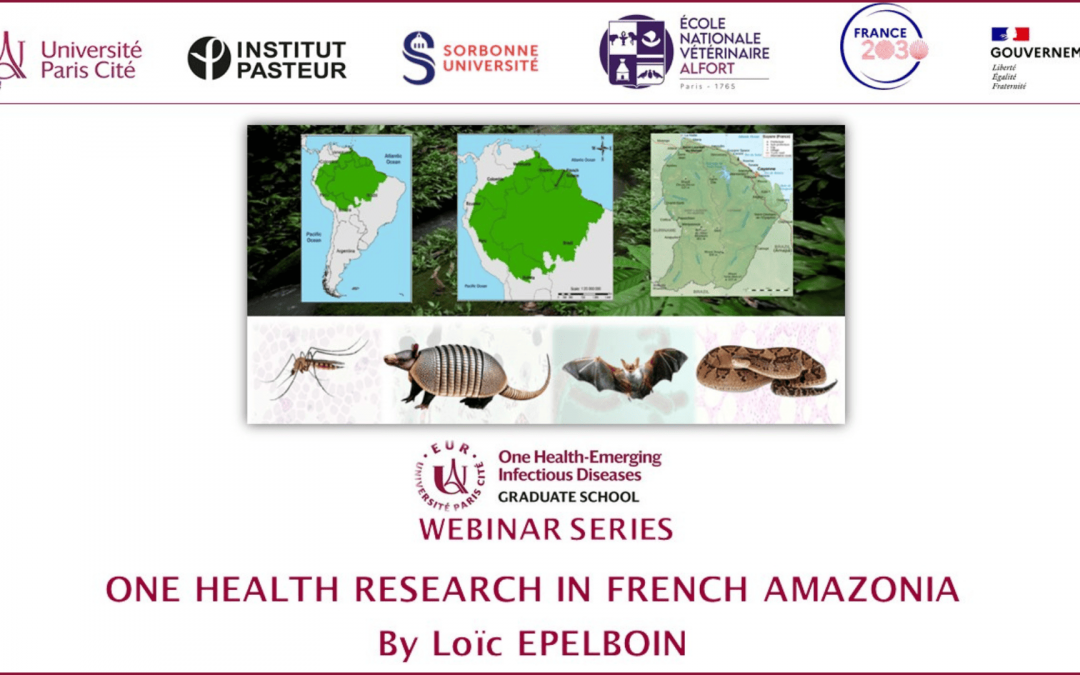
The Amazon, Viruses, and Vampires: what a year of One Health-Emerging Infectious Diseases webinars revealed to the world
Amazonie, virus et vampires : ce qu’un an de webinaires “One Health -Emerging Infectious Diseases” a révélé au monde

Une étude ouvre une nouvelle voie pour prévenir les infections graves du nourrisson
Les infections invasives à pneumocoque, telles que les méningites ou les septicémies, restent une cause importante d'hospitalisation et de complications chez les jeunes enfants. Une étude française, coordonnée par la Dr Inès Fafi et le Pr Naïm Ouldali, du service de...

Rentrée 2026-2027 : les dates à connaître
Les informations relatives à la rentrée 2026-2027, à vos formations ainsi qu'aux services dont vous pouvez bénéficier sont disponibles sur les sites internet des Facultés – Santé, Sciences, Sociétés & Humanités – et de l'Institut de physique du globe de Paris....