

Our research policy
In a French landscape that is being restructured into major clusters, with the ambition of recreating several world-class universities in France, Université Paris Cité represents a leading force in research, already highly visible nationally and internationally.

If the core vocation of Université Paris Cité is first and foremost research at the highest level, it pays great attention to the major societal issues and to the training through research of the future actors of French society.
Nearly one out of ten scientific articles published in France comes from the laboratories of Université Paris Cité. As the leading French university in terms of citations per article, it awards 8% of doctorates at the national level and develops research of the highest international standard, directly connected to international issues and players, with a particular ambition on a European scale.
By focusing on new forms of collaboration with national research organisations and the AP-HP, as well as on new modes of governance and steering of research and training, Université Paris Cité aims to enhance its visibility and attractiveness even further.
Fundamentally multidisciplinary and with a solid experience of interdisciplinarity, Université Paris Cité develops high-level research in all fields of knowledge, from the exact and experimental sciences to the human and social sciences.
It is notably visible in the fields of earth sciences, medicine and, more broadly, biology and health, and brings together one of the largest groups of laboratories associated with the CNRS and INSERM.
It is also expanding its research potential by developing numerous research programs with its USPC partners. More broadly, Université Paris Cité is committed to collaborating with all the major players in national and international research.
The research policy of Université Paris Cité is built in a concerted manner with its faculties, components and research structures, in close collaboration with national research organizations. Its main strategic directions are broken down into sectors of excellence to be supported, themes to be strengthened, new disciplinary fields to be developed and interdisciplinary interfaces.
It has a voluntarist international policy to attract the best teacher-researchers and researchers at all stages of their careers. In particular, this policy allows the establishment of new research areas on emerging themes.
It relies on a range of mechanisms to encourage ambitious projects, in partnership with regional, national, European and international players.
Read more
Eiffel Excellence scholarship 2027
The Eiffel scholarship programme launched by France’s Ministry of Europe and Foreign Affairs is now open for the 2027–2028 academic year. The programme enables international students to benefit from a mobility grant and pursue courses at the master’s and doctorate...

Call for Interdisciplinary Research Proposals: Sciences Po & Université Paris Cité 2026
As part of the partnership between Université Paris Cité and Sciences Po, a new call for proposals has been launched to identify large-scale, interdisciplinary and collaborative research projects addressing major contemporary issues. This call will take place in two...
Université Paris Cité stands out once again in the 2026 Shanghai thematic ranking
The Shanghai Global Ranking of Academic Subjects (GRAS) has just unveiled its results for the 2026 edition on Tuesday 15 September. Université Paris Cité has excelled by being ranked in 26 disciplines - including 10 in the global top 50 - and by achieving 1st place in...
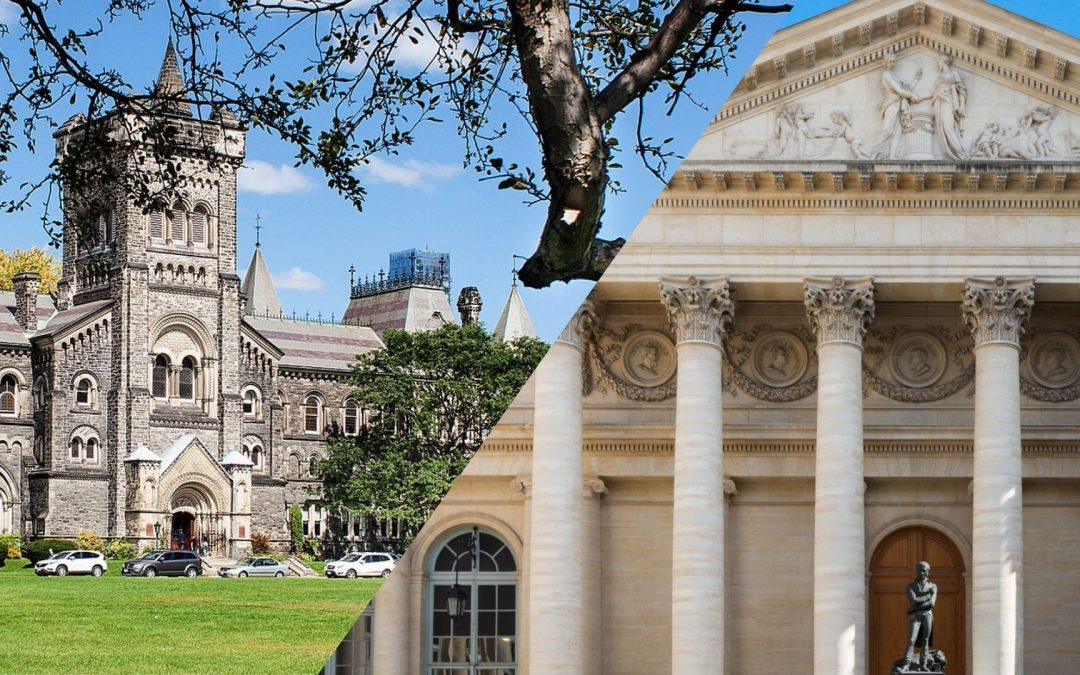
Doctoral Mobility: Results of the Call for Projects between Université Paris Cité and the University of Toronto
As part of the strategic partnership between Université Paris Cité (UPCité) and the University of Toronto (U of T), supported by the Initiative d'Excellence (IdEx), the call for doctoral mobility projects launched in 2026 aims to develop joint activities around themes...