

Using a technique traditionally used in civil engineering, two seismologists, including Yann Klinger, a researcher at the Institut de Physique du Globe de Paris, have highlighted the stratigraphic succession of major earthquakes over the past 2,000 years south of the San Andreas fault in California. In this study, published at the beginning of July, they were able to identify variations in the seismic activity of the fault in this sequence, linked to the different historical water levels of the overlying lake, and thus better assess the rate of slip of this major fault in the western United States.
The Salton Sea is the largest freshwater reserve in southern California. Its level has varied considerably over time as a result of changes in the course of the Colorado River, with episodes of complete drying up, when the Colorado empties into the Gulf of California, and periods of filling well above the current level, when the river empties into the Salton Sea depression. The variations in this lake, also known as Lake Cahuilla, have been well documented and dated over the last few thousand years.
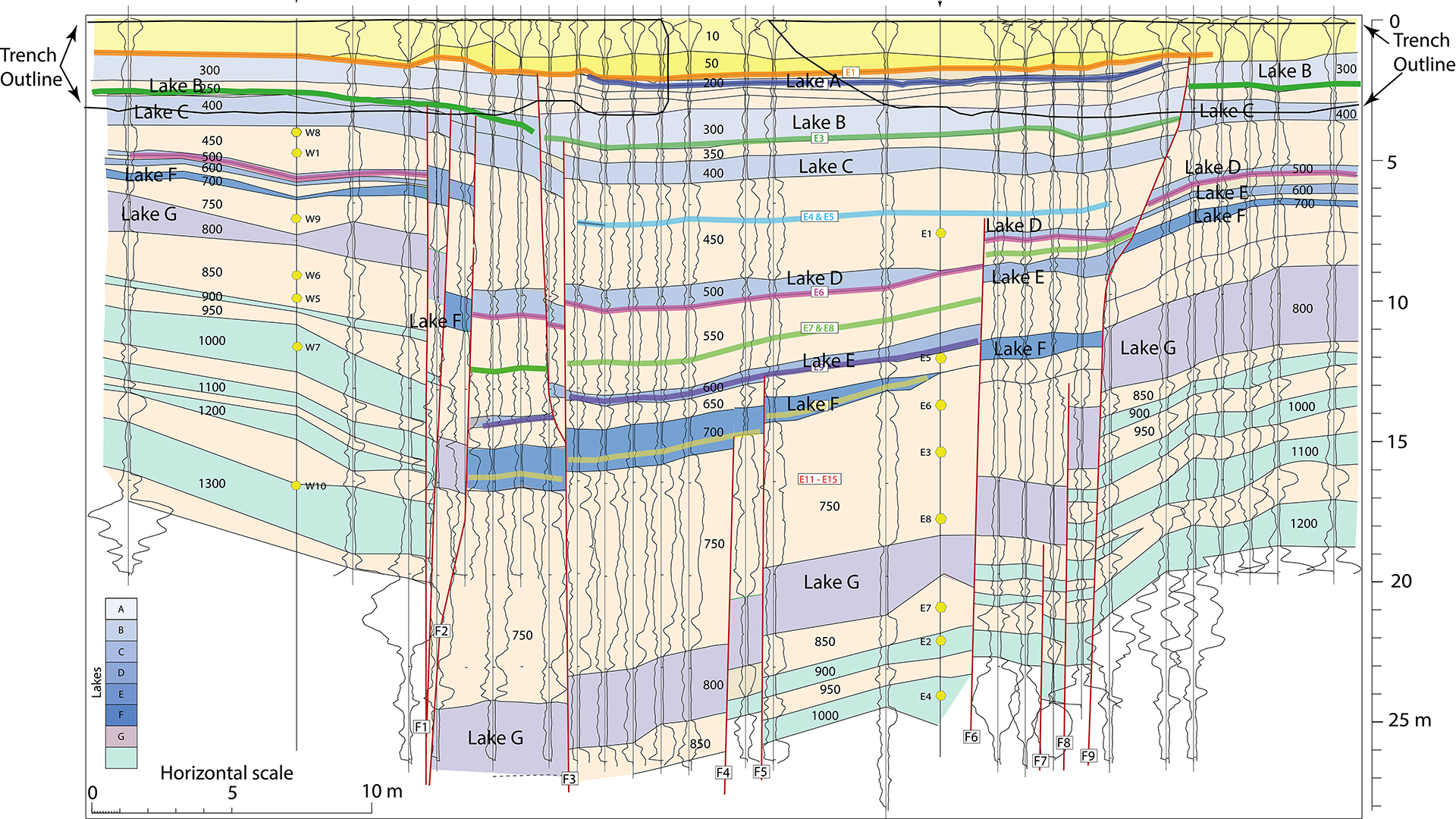
The authors, T. Rockwell (University of San Diego, California) and Y. Klinger (IPGP, Université Paris Cité, CNRS), of this study published in the journal Earth and Planetary Science Letters, have identified, on aerial photographs taken just after the Mw7 earthquake that affected the southern section of the San Andreas fault, the Imperial fault, in 1940, a small basin in extension favourable to the accumulation and preservation of sediments over time. Depending on the level of the Salton Sea, this small basin was either under lacustrine or alluvial depositional conditions. Using a drilling method commonly used in civil engineering (Cone Penetrative Test), the team determined the stratigraphic succession of deposits throughout the basin to a depth of 20m, and highlighted episodes of subsidence associated with major earthquakes in the past. By correlating the dating of shells collected in two cores taken from the basin and the chronology of the various high levels of Lake Cahullia, it was possible to establish a detailed chronology of the major earthquakes on this fault over the last 2,000 years. This chronology of major earthquakes shows that the temporal distribution of these major earthquakes is by no means regular over time.
As the two types of sedimentary deposits in the basin are easily distinguished by their composition and grain size (clay vs. sand and clasts), it has been possible to identify a very marked acceleration in seismicity around 1000 years ago, when Lake Cahullia filled up after a long period of drying up. Once the basin had refilled, seismicity returned to a more moderate level, suggesting a seismic response of the fault to the transient filling of the lake. Given the geometry of the fault, which lies in the middle of the lake, mass differential is not the preferred hypothesis for the factor controlling the temporary increase in seismicity, but rather the percolation of fluids in the fault zone which can, among other things, locally reduce the normal stress on the fault surfaces.
Furthermore, considering that the newly detected earthquakes in this study are all of approximately the same size, with horizontal displacements of a few metres, the authors propose that during this period of more intense seismicity, which lasted around 400 years, the slip-rate on this section of the fault must have been faster, reaching an estimated value of around 17 mm/year compared with 5 mm/year at present. Thus, the total deformation budget could have been largely consumed, which could explain the current absence of major earthquakes on the southern segment of the San Andreas fault.
Références :
> Thomas K. Rockwell, Yann Klinger, 2000 yrs of earthquakes inferred from subsidence events on the Imperial fault, California: Effect of lake-level changes and implication for variable slip rates, Earth and Planetary Science Letters, Vol 618, 2023, 118271, ISSN 0012-821X,
Read more

Eiffel Excellence scholarship 2027
The Eiffel scholarship programme launched by France’s Ministry of Europe and Foreign Affairs is now open for the 2027–2028 academic year. The programme enables international students to benefit from a mobility grant and pursue courses at the master’s and doctorate...
read more
Call for Interdisciplinary Research Proposals: Sciences Po & Université Paris Cité 2026
As part of the partnership between Université Paris Cité and Sciences Po, a new call for proposals has been launched to identify large-scale, interdisciplinary and collaborative research projects addressing major contemporary issues. This call will take place in two...
read more
A journey to self discovery – the story of a Circle U. Student Fellow
What if one conference could change the direction of your studies and make you rethink what you want to do with your future? This is the story of Emma, who discovered a new path through an unexpected Circle U. opportunity. Her experience is a reminder of the value of...
read more
Université Paris Cité stands out once again in the 2026 Shanghai thematic ranking
The Shanghai Global Ranking of Academic Subjects (GRAS) has just unveiled its results for the 2026 edition on Tuesday 15 September. Université Paris Cité has excelled by being ranked in 26 disciplines - including 10 in the global top 50 - and by achieving 1st place in...
read more